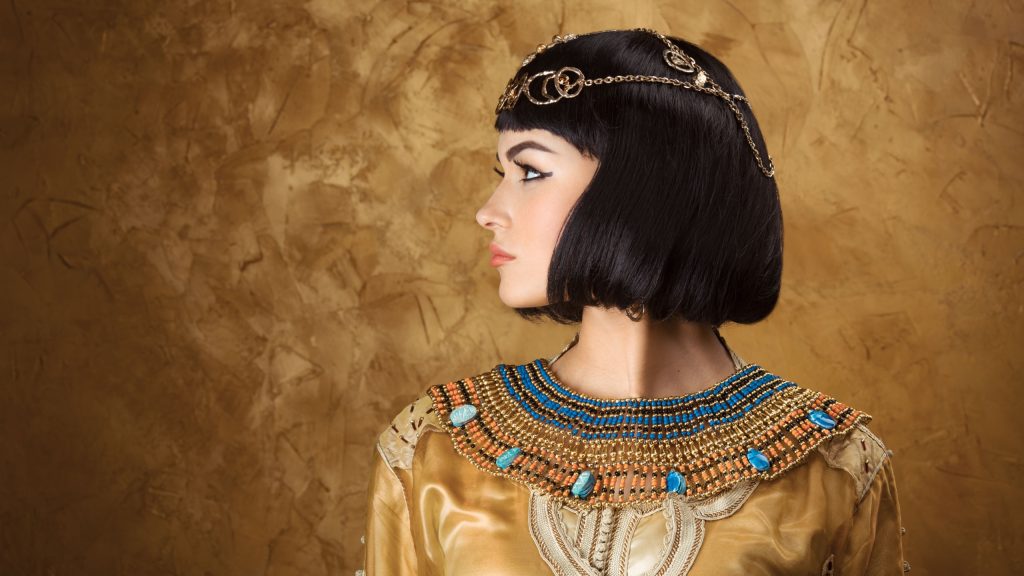
Cleopatra is easily one of the most famous people from ancient Egypt. No wonder she’s in so many movies & books. However, the historical version of her is a little different from the way that the media portrays her, and most people don’t know some of the most interesting things about her.
Here are ten intriguing facts about Cleopatra. Which one surprised you the most?
She spoke many regional languages
Writers from Cleopatra’s time said that she very rarely required an interpreter. Instead, she was able to switch between various languages with ease, sometimes even speaking to visitors directly herself.
It was quite unusual for a Ptolemaic ruler at that time. Her native language was Greek, and she could also speak Egyptian & supposedly seven other languages, too.
She was a technical author
You might not think of Cleopatra as a scientist or author. But technically, she was. Cleopatra wrote & produced a lot of specialized material that suggests she had a good knowledge of medicinal formulas and magical practices of the time.
She also knew some early ideas of alchemy. Not bad for someone who was “just” a queen.
She tested poisons on condemned prisoners
One of the not-so-nice facts about Cleopatra is that she supposedly tested poisons on prisoners.
Plutarch & later writers claim that the queen wanted to see how different toxins work, including snake venoms and plant-based poisons. She also wanted to see how fast they acted and people’s symptoms once they took them.
She tied her public image to the goddess Isis
A lot of Cleopatra’s public image was connected to the Egyptian goddess, Isis. Many of her symbolic decorations & inscriptions were meant to mirror the goddess of fertility, due to Cleopatra’s status as royal mother.
In fact, Roman accounts claim there was a golden statue of Cleopatra. It was apparently in Caesar’s Temple of Venus Genetrix.
She followed the Ptolemaic habit of marrying her brothers
Cleopatra grew up in a royal family that had a long history of marrying their siblings. She was no different. Cleopatra first ruled & married her brother Ptolemy XIII until their relationship broke down, leading to a civil war.
She then married her younger brother, Ptolemy XIV, before he died. Rumor has it that Cleopatra poisoned him so that their son, Caesarion, could rule Egypt.
She had a signature perfume tied to a real workshop site
Cleopatra really enjoyed strong & warm perfumes, and Mendesian was one of her most famous ones. The perfume’s creation was connected to a real production site at Tell Timai.
It was a mix of myrrh, cinnamon & oil from the Nile Delta. It’s probably one of the reasons why people thought Cleopatra was so glamorous.
A single Greek word may be the only bit of her handwriting
Sadly, we only have one surviving example of what could be Cleopatra’s own handwriting. It’s incredibly short.
There’s a tax-related decree that has the Greek word ginesthoi written at the bottom. It essentially means “let it be done.” While it may be rather small, historians believe it’s the most likely example of her writing that we still have today.
She may have hosted scientific demonstrations with live animals
Writers from Cleopatra’s time mentioned that the queen had gatherings that involved many scholars. They would do demonstrations for the court.
One of these gatherings included her watching people test weight & movement using animals as props. However, these weren’t exactly formal lessons. These were displays for court thinkers to show off Greek physics.
She supposedly won a huge bet by drinking a dissolved pearl
Cleopatra was apparently a rather competitive person. So much so that, according to legend, she showed up to a dinner with Antony & wore enormous pearl earrings. She dropped one into strong vinegar until the pearl softened.
Later, the story says that Cleopatra drank the dissolved pearl. Why? Because she wanted to settle a bet about hosting the most expensive banquet.
Ancient accounts give conflicting explanations for her death
One of the most intriguing details about Cleopatra is that we don’t actually know how she died. One writer, Strabo, claims that she killed herself through the bite of an asp, or a prepared ointment.
However, Plutarch claims she committed suicide with a secret device, like a hollow hairpin. Cassius Dio wrote about tiny wounds. Who knows what really happened?
The following sources were consulted in the preparation of this article:
- Cleopatra’s Languages
- Cleopatra VII: Scholar, Patron, Queen
- Toxicology and snakes in ptolemaic Egyptian dynasty: The suicide of Cleopatra
- Cleopatra the Great: Last Power of the Ptolemaic Dynasty
- The expulsion of Cleopatra VII: context, causes, and chronology
- Eau de Cleopatra: Mendesian Perfume and Tell Timai
- Make It So! Sayeth Cleopatra
- Three Ways Cleopatra Contributed to Science and Medicine
- Cleopatra’s Cocktail

