Most humans settle into long partnerships that last much longer than a single season. A few animals do the same. Yes, several birds & mammals, reptiles & reef fish raise their young together, just like humans do.
Here are thirteen animals that are known to mate for life. Which of these animals do you think has the most romantic life?
Wandering albatross
Wandering albatrosses aren’t the kind of animals to rush into a relationship. They take their time with slow dances & circling flights, then they’ll finally settle into a relationship. It’s a “marriage’ that can last several decades.
That’s not to say they’re always around each other, though. Wandering albatrosses reunite on the same island after spending months apart over the ocean.
Whooping cranes
Another bird that mates for life is the whooping crane. They find their partner once they’re just a few months old & nest together as a set.
You can easily notice these birds, since their “duet” calls are quite loud, and you can see them guarding the nest in their marshes. The birds swap long incubation shifts with each other. It’s a give-and-take sort of relationship.
Sandhill cranes
Most sandhill cranes find their mate when they’re together in huge seasonal flocks. They’ll return to the wetlands every year once they’ve made their choice.
Their mating dances involve big leaps & wing stretches, as well as a lot of stepping around. Interestingly, it keeps their bond strong. It’s one of the reasons they stay together for their entire lives.
Barn owls
You probably know that barn owls live in barn lofts or hollow trees. But did you know they usually mate for life, too?
Yes, these birds will roost close together and bring back mice for each other. But that’s not all. Should a partner disappear or die, the survivor will keep the spot, almost as though it’s waiting for the other to return.
French angelfish
Even underwater animals stick together. French angelfish are the perfect example. They’ll swim together as a pair, side by side, guarding a piece of reef that they’ve claimed as they won.
They’ll then rise towards the end of the day and mate. It’s something that bonded partners repeat for years.
Prairie voles
Yes, prairie voles are tiny. But their hearts are anything but small since, after mating, a male often stays close.
They’ll share the nest & warm the pups with the female, huddling and grooming each other the entire time. The mammals move around as a unit. The adults will stick together across all the seasons because they’re that close.
Eurasian beavers
Eurasian beavers are just as committed as voles. There’s often one adult male & female raising all the young inside each lodge.
The older offspring help their parents to repair dams and collect branches, so it’s kind of like a little family workforce. The parents often stay together for many years. They’ll keep any other adults out of the home.
Shingleback lizards
Researchers in Australia noticed that shingleback lizards kept appearing in pairs. It happened so often that they began tracking them, learning that many of these animals had met up every spring for many years.
The female usually leads the pair. You can often see the two of them sharing shaded spots together because they genuinely care for each other.
Gibbons
Like humans, gibbons have a long-term adult pair that leads the family. But unlike humans, the pair usually sings together in the morning.
They travel through the same patch of trees & raise their young together. As for their partnership? It lasts for quite a few years.
Kirk’s dik-dik
You might not have heard about Kirk’s dik-dik. But these animals control small home ranges in pairs in East Africa, and the male of the species usually stays close to his partner.
It’ll put scent marks over the female’s scent. It makes it clear to other dik-diks that the pair is bonded together for life.
Azara’s owl monkeys
It shouldn’t be surprising that some monkeys mate for life. Azara’s owl monkeys are one of these monkeys, and they’ll nap through the day with their partner & young.
They might also do so with an older sibling. The male Azara’s owl monkey often carries the babies, but both mom and dad take responsibility for finding food.
Common marmosets
A common marmoset family usually involves three members. Who are they? A male, a female, and some helpers from earlier litters.
The pair stays bonded for years & they work together to find out where they’re going to move, as well as how they’ll deal with infant care.
Atlantic puffins
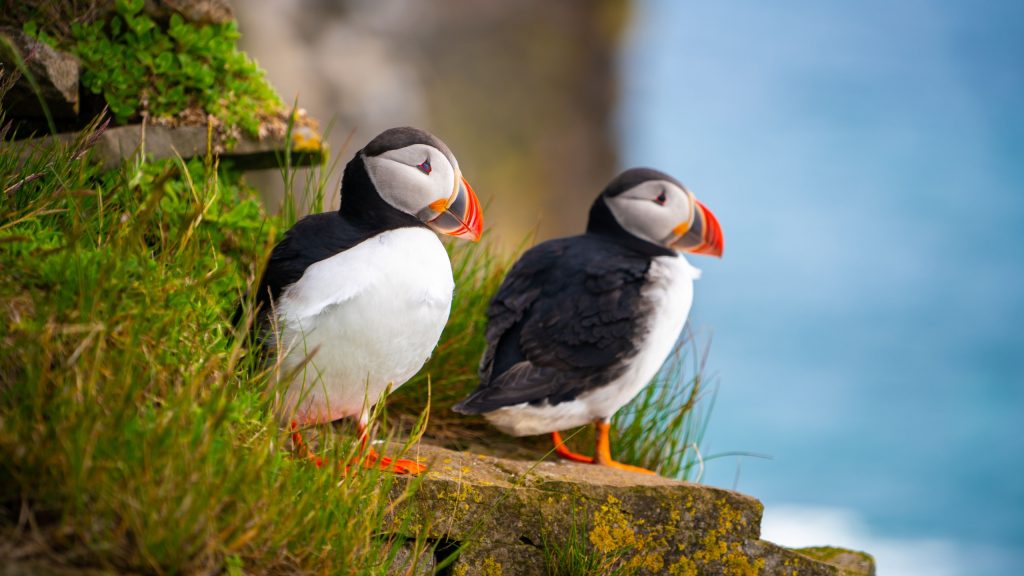
It doesn’t matter that Atlantic puffins spend months in open water. They’ll show up at the same cliff colonies as soon as spring comes, and pairs of the birds usually stay in the same burrow.
They’ll tidy it up together & clear out the old debris. Atlantic puffins take turns to warm their single egg, and then they’ll bring it food once the chick has hatched.
The following sources were consulted in the preparation of this article:
- Boldness predicts divorce rates in wandering albatrosses (Diomedea exulans)
- Birds choose long-term partners years before breeding
- Sandhill cranes
- Tyto alba (Barn Owl)
- Pomacanthus paru
- The prairie vole: an emerging model organism for understanding the social brain
- Time budgets and sex differences in the Eurasian beaver
- Social monogamy and extra-pair fertilization in an Australian lizard, Tiliqua rugosa
- Hylobatid communities: Changing views on pair bonding and social organization in hominoids
- Monogamy in the dik-dik
- Social Monogamy in Wild Owl Monkeys (Aotus azarae) of Argentina: The Potential Influences of Resource Distribution and Ranging Patterns
- The pair-bond of the common marmoset, Callithrix jacchus jacchus: An experimental investigation
- Fratercula arctica: Atlantic puffin

