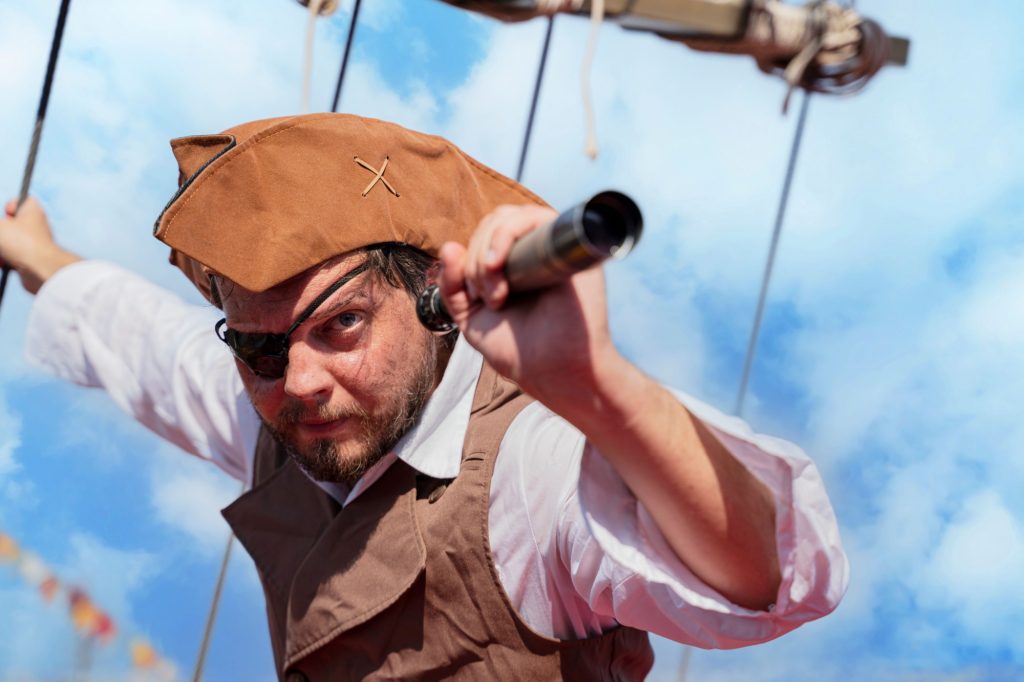
Most people imagine eye patches & parrots whenever they think of pirates, and a whole lot of “arrr.” Unfortunately, films & books did a great job of mixing fact with fiction. The truth about them is a lot stranger than the stories, so here are six myths & facts about pirates. Which of these myths fooled you the longest?
Featured Image Credit: Shutterstock.
Pirate speech sounded like “arrr”
Everyone knows that classic pirate growl. But it turns out that it’s not real, as it came from a 1950 film featuring the actor Robert Newton, who played Long John Silver with a West Country accent. Audiences loved it. So much so that everyone started thinking it was how pirates talked, when really, they spoke in whatever accents they grew up with, like a London or American one.
Every pirate flew the skull-and-crossbones
Not every ship had the same black flag with bones & skulls. Some had red flags, while others painted hourglasses or bleeding hearts, mostly because being a pirate wasn’t a brand. The goal of a flag was to scare the target into giving up quickly. In fact, the famous Jolly Roger flag was just one of many designs at sea, although it’s probably the most remembered one.
Piracy only happened in the Caribbean
Piracy didn’t simply involve palm trees & rum. Actually, the Indian Ocean was one of the most popular places for pirates, who would strike along East Africa & India. Even Madagascar had bases for crews who sailed out to rob trade routes. Sure, the Caribbean was busy, but piracy stretched across almost every ocean & wasn’t confined to this one place.
Pirate ships had no rules or structure
Many people imagine pirates as being lawless crews on board a ship. But records show the opposite. Usually, crews wrote down articles that worked like contracts, covering pay & discipline, as well as injury insurance. They also elected captains and had quartermasters to balance their power, meaning that even these rogues ran things with surprising organization.
Pirates made people walk the plank
One of the most famous pirate myths is that they made people walk the plank as punishment. Sadly, it’s not real, as the idea only really appeared in the late 1700s. This was long after the so-called Golden Age of piracy. It’s thanks to writers in the 1800s who kept using it in adventure stories that we have this myth. Actual pirate punishments were usually quicker & more brutal.
Pirates drew “X marks the spot” maps
Treasure maps with giant Xs are a product of fiction that started with Robert Louis Stevenson’s Treasure Island. Scholars haven’t been able to find any authentic pirate maps that have these markings. That’s mostly because pirate crews very rarely buried their loot. And even if they did, they would hardly leave behind handy diagrams for anyone to follow.
The following sources were consulted in the preparation of this article:
- “A Voice So Cruel, and Cold, and Ugly”: In Search of the Pirate Accent
- The ‘Jolly Roger’ (Pirate Flag)
- An‐arrgh‐chy: The Law and Economics of Pirate Organization
- Imitation fiction: Pirate citings in Robert Louis Stevenson’s Treasure Island
- X Marks the Spot—Not: Pirate Treasure Maps in Treasure Island and Käpt’n Sharky und das Geheimnis der Schatzinsel