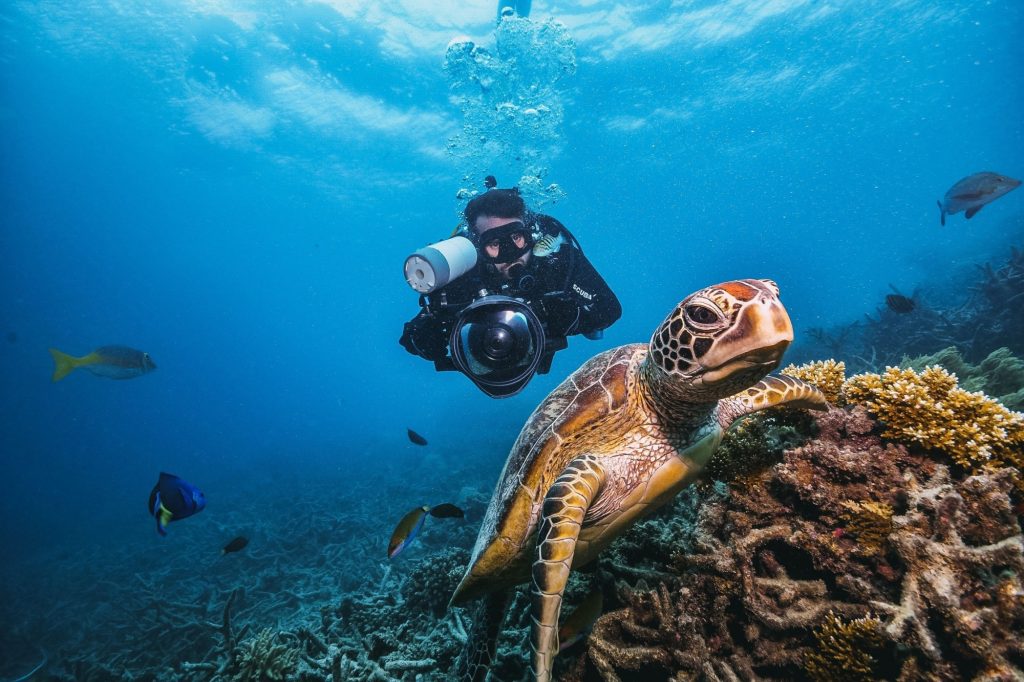
The Great Barrier Reef is more than a big patch of coral off Australia. Sure, people know it’s huge & colorful, but it also works as its own living, breathing world. It even has some quirks you wouldn’t expect. Here are seven interesting facts about the Great Barrier Reef, backed by science (see the end). Which of these do you think is most fascinating?
Featured Image Credit: Shutterstock.
Mass coral spawning comes after spring full moons
Think about the biggest block party you’ve ever seen. Now imagine it underwater. Once a year, right after a spring full moon, corals all around the Great Barrier Reef release their eggs & sperm at the same time. It only lasts a few nights. But that doesn’t make it any less incredible.
Crown-of-thorns starfish produce huge numbers of eggs
Crown-of-thorns starfish are essentially baby-making machines. A single female can lay tens of millions of eggs in one season. Yes, millions. Unfortunately, it’s not all good news, as when there are too many of these starfish, they chew through the coral incredibly fast. Studies show they’re a major reason coral cover on the reef has declined.
The reef releases dimethylsulfide gas into the air
The Great Barrier Reef actually gives off a gas called dimethylsulfide, also known as DMS. It comes from tiny algae living inside corals. Measurements show that the reefs release DMS into the air during low tides, where it can drift into the atmosphere. Who knew coral could be so gaseous?
Underwater reef sounds help restore fish to degraded areas
Researchers conducted a strange experiment on damaged reefs. They set up speakers & played recordings from healthy reef areas. But instead of silence, those patches started filling up with more fish within weeks, with the sound mostly being clicking shrimp & fish calls. It worked like a magnet.
Reef snakes stay put
The reef is home to sixteen different species of true sea snakes. Most of them aren’t wanderers. Studies found they stick close to the reefs where they were born & rarely move to neighboring systems. As a result, populations in different reef zones remain completely separate. That’s quite unusual for wide-ranging marine species.
The modern reef began only about 9,500 years ago
Most people know that the Great Barrier Reef has been around for a long time. But the modern version hasn’t been around as long as you might think. It formed after the last ice age when rising seas flooded the continental shelf & core samples show this happened roughly 9,500 years ago. However, reef-building in the area started much earlier.
Some reef corals can glow neon at night
Swimming under the Great Barrier Reef is an incredible experience. It’s even better when you do it under UV light because you’ll see that parts of the reef actually glow. In fact, scientists have recorded all sorts of colors. They’ve cataloged more of them in the Great Barrier Reef corals than anywhere else.
The following sources were consulted in the preparation of this article:
- Moonrise timing is key for synchronized spawning in coral Dipsastraea speciosa
- Laboratory study on the relative predation rates of crown-of-thorns starfish (CoTS) larvae by five fish species
- The contribution of coral-reef-derived dimethyl sulfide to aerosol burden over the Great Barrier Reef: a modelling study
- Acoustic enrichment can enhance fish community development on degraded coral reef habitat
- Distribution of sea snakes in the Great Barrier Reef Marine Park: Observations from 10 yrs of baited remote underwater video station (BRUVS) sampling
- A Potted Geological History of the Great Barrier Reef
- Why corals glow even in the depths of the sea