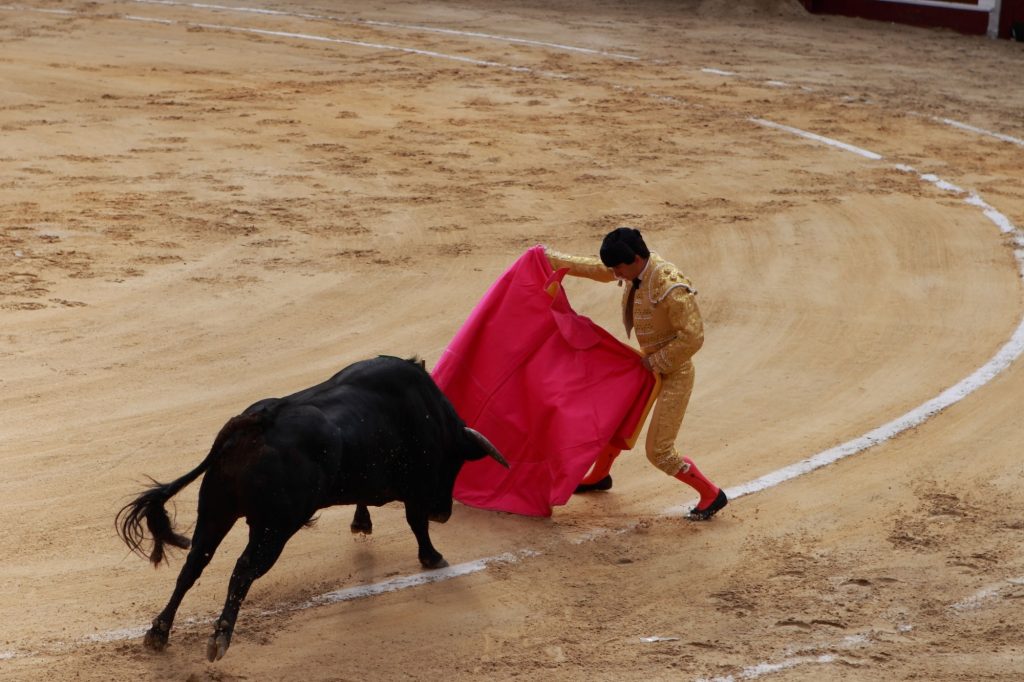
It doesn’t matter what the movies show. Bulls don’t care about the color red, and the truth’s far more interesting than you might realize, especially since bulls’ eyes don’t even work like ours. Let’s find out what’s really going on with them. What’s the most unusual animal fact that you know about?
Featured Image Credit: Shutterstock.
Cattle see two cone colors, not a true red
Bulls’ eyes are wired differently from humans, and instead of three color sensors like us, they only have two. Neither one of these is tuned to red. As such, when they look at that famous cape, it’s essentially just another shade of dull grayish-green, and there’s no red alert going on in their brains.
Red versus green
When light levels are balanced, cattle also have a hard time telling one hue from another because their eyes rely more on brightness differences than subtle color shifts. They’re unable to pick red over green unless the lighting’s uneven. When both of them look equally bright, it’s more of a guessing game when they’re trying to spot the difference.
The importance of movement
So what’s going on? When the cape’s completely still, the bull normally does nothing & just stands completely still. But the second that thing swishes, the animal snaps to attention. This is because bulls rely on motion to decide whether something’s a threat. The color itself is background noise for a bull, compared to a sudden flick or wave.
Fighting cattle show no pull to red
Spanish fighting bulls don’t care more about red than any other color. In fact, most bulls simply react to whatever is in front of them when it moves, and a bright blue tarp would do the trick just as well as a red one. However, most shows use red because it’s easier for humans to see, not the bulls.
Two capes, two colors
Usually, bullfighters use two capes. The first one is often magenta & gold, which the bulls charge at just fine, while the red one is used later mostly for tradition. It also masks the animals’ blood stains. However, in practice, both colors get equal attention from the bull because it’s the waving motion that sets them off instead of the shade.
Red became the usual choice in the 1800s
Matadors didn’t use to have a strict color rule. In the early days, the fighters waved white or yellow cloth, sometimes blue, as red wasn’t the most popular option. It took until the 1800s for it to become the standard. Bullrings across Spain began using the red muleta, and by the late 19th century, it was practically the only option.
The following sources were consulted in the preparation of this article: