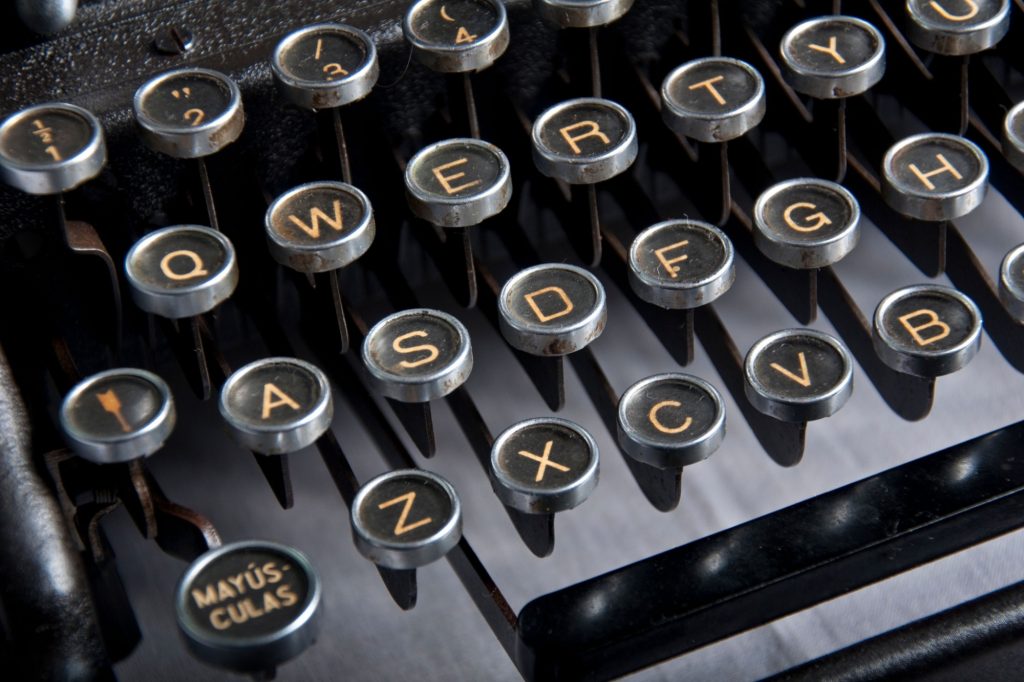
Typewriters weren’t easy machines to use in the 1870s. They had metal arms that crashed into each other whenever someone got a little too fast. However, out of that mess came QWERTY & with it, the idea that this was deliberately arranged to slow people down. But is this actually true, or just a catchy myth that stuck around? Let’s find out.
Featured Image Credit: Shutterstock.
The mechanical problem on early machines
Essentially, the first typewriters were a bunch of thin metal bars all swinging toward the same point. Two that got there almost at the same time would jam together, which stopped everything. Unfortunately, the only way to fix it was to reach in & pull them apart. This meant inventors had to find a way to keep the most common letters from bumping into each other.
The change from alphabet rows
Christopher L. Sholes first tried using a simple alphabetical layout for the keyboard. But that didn’t last long. The constant jamming problem meant he had to shuffle things around, and he kept rearranging letters to space out those problem pairs. What started as a neat A-to-Z setup slowly turned into something far less tidy.
The Remington step
Remington began creating typewriters & things started to look more familiar. The company put the machine into production, and by mid-1874, buyers got their hands on a version that had the bones of the QWERTY keyboard. Now, it was no longer a tinkerer’s experiment, but a commercial product you could actually order.
What the 1878 patent actually shows
A few years later, Sholes locked things in officially with an 1878 patent that included a diagram showing the early QWERTY layout. But why? Putting certain letters farther apart in the type basket reduced the chance of two bars swinging next to each other too quickly. In doing so, the machine worked a lot better than before.
Was the aim to slow the operator?
There’s a myth that the layout was meant to slow everyone down. However, the records don’t really support that, since Sholes’s main goal was to avoid jams & make the machine reliable enough to sell. Changes to speed were a side effect more than an active aim.
The arrival of the shift key
Shortly after QWERTY started hitting the market, Remington released a version with a shift key so you could use uppercase & lowercase easily. The update stuck rather quickly. It made typing quicker & trimmed the number of keys. But it also kept the layout mostly the same, and for a design that’s often accused of slowing things down, this went in the opposite direction.
What early models left off the keyboard
Interestingly, some of the earliest office machines didn’t even bother including a full set of number keys. The numerals 1 & 0 were missing entirely on certain models. Operators had their own workarounds, where “i” doubled as a 1 & “O” covered 0. It’s all because those keyboards were built with different priorities than modern ones.
The following sources were consulted in the preparation of this article: