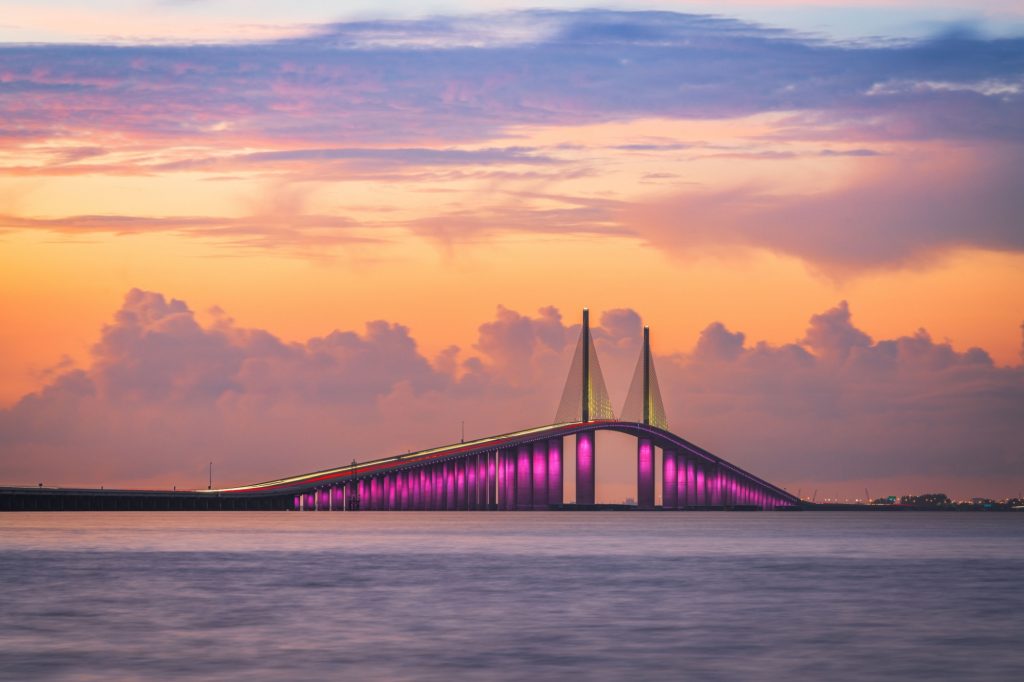
Driving across Florida’s Sunshine Skyway Bridge is a weird experience. It feels like it hovers slightly above the water & has massive tankers gliding underneath, although that’s not the reason sailors and locals feel queasy around it.
It’s the deadly accidents that happened on the bridge that gave it its reputation for swallowing ships. What happened? Let’s find out.
Key takeaways
Here’s what you’ll learn about:
- Details about the bridge’s height & shape
- What led up to the 1980 crash, and how it happened
- What engineers learned from the crash
- How the crash gave the bridge its reputation
A long single-stem channel that funnels big ships
Tampa Bay’s shipping lane is quite thin, and it cuts through shallow seafloor, measuring approximately 70 miles from the Gulf to the port docks. There are about 42 miles of deepwater channel. They are roughly 500 ft wide & 43 ft deep.
The Skyway Bridge crosses above the only safe path of this shipping lane, so every oil tanker or bulk carrier that’s going to Port Tampa Bay will need to pass directly under it. It’s the same story for cruise ships going to Port Manatee.
The clearance
The newest version of the bridge has quite a bit of clearance at around 180.5 ft (55 m) at high tide. But even that’s not enough for big ships. There’s an NOAA station built into the bridge that shares the live number, known as an air gap reading, to boats to make sure they know how much space they have.
Staff on the boat will check these numbers before each approach. They will then match the figure with their own ship’s stats, including the antennas & masts. It’s much better than guesswork. Knowing exactly how many feet they have to spare before going beneath the cables helps them avoid similar disasters to the 1980 one.
The day everything went wrong
The disaster happened on May 9, 1980. Shortly after 7:30 a.m., the MV Summit Venture, a bulk carrier, was going towards Tampa Bay. Then the weather changed. Visibility fell & winds became rather strong across the narrow channel. These factors caused the ship to veer just so slightly off course.
Unfortunately, “slightly” was all it took for disaster to strike because the ship struck one of the bridge’s support piers. It tore away around 1,400 ft of roadway. Sadly, several vehicles went straight into the water below, including a Greyhound bus, and 35 people were killed. It was one of the worst transportation disasters in the state’s history, even to this day.
The original structure versus the strike
The original bridge was quite different from the one that exists today. The original bridge opened in 1954 & its steel cantilever span was built in 1971. The Summit Venture struck the concrete base first with its bow, then its upper hull slammed directly into the pier’s vertical support.
What made this disaster so bad was that the bridge had no outer barrier to absorb any extreme shocks. The force of the strike went straight into the truss & snapped it like a matchstick.
What changed afterward
The 1980 disaster forced engineers to rebuild the bridge, and they did so with different ideas in mind. They created the Bob Graham Sunshine Skyway Bridge in 1987. It stands higher than the original & has fewer piers in the water, with each one sitting inside a circle of large concrete dolphins.
However, those dolphins aren’t merely for design. They’re designed as circular walls that can absorb the impact of a ship striking the bridge before it reaches the support columns.
That’s not all. The bridge also features a secondary fender system that’s made to deform & take the energy from any smaller hits. These structures work together to protect the bridge from another incident like the one in 1980.
How ships are guided and protected at bridges
Ships also travel rather differently past the bridge & no longer rely on guesswork. They use radar ranges and GPS positions to work out exactly where they are, while also receiving local traffic control updates from port authority stations.
Ships going past other bridges across the country do the same thing. In cities like New York & San Francisco, engineers used the mistakes of the Sunshine Skyway Bridge to learn how to improve bridge safety.
They added bigger fenders & warning lights, as well as remote monitoring. National safety standards were a direct result of the Skyway disaster.
What “ship-swallowing” really means
So why do people say that the bridge swallows ships? The nickname came from the wreckage of the disaster, when drivers saw the bridge vanish under the ship’s bow. It looked like the water had eaten it.
Today, the nickname has stuck because it shows just how quickly conditions can change and spell out disaster. The modern version of the bridge is mostly prepared for this. It has high clearance & strong fenders, along with live air-gap data. Engineers have mapped the channel right down to the foot.
These days, the only thing that “swallows” the ships is the horizon when they disappear past the bay’s curve.
The following sources were consulted in the preparation of this article:
- Marine Accident Report: Ramming of the Sunshine Skyway Bridge by the Liberian Bulk Carrier M/V Summit Venture, Tampa Bay, Florida, May 9, 1980
- Ship Collisions with Bridges: The Nature of the Accidents, Their Prevention and Mitigation
- Sunshine Skyway set the standard for bridge protections. They weren’t present in Baltimore
- Tampa Harbor Navigation Improvement Study
- Sunshine Skyway Bridge Vertical Clearance
- Safeguarding Bridges from Vessel Strikes: Need for Vulnerability Assessment and Risk Reduction Strategies