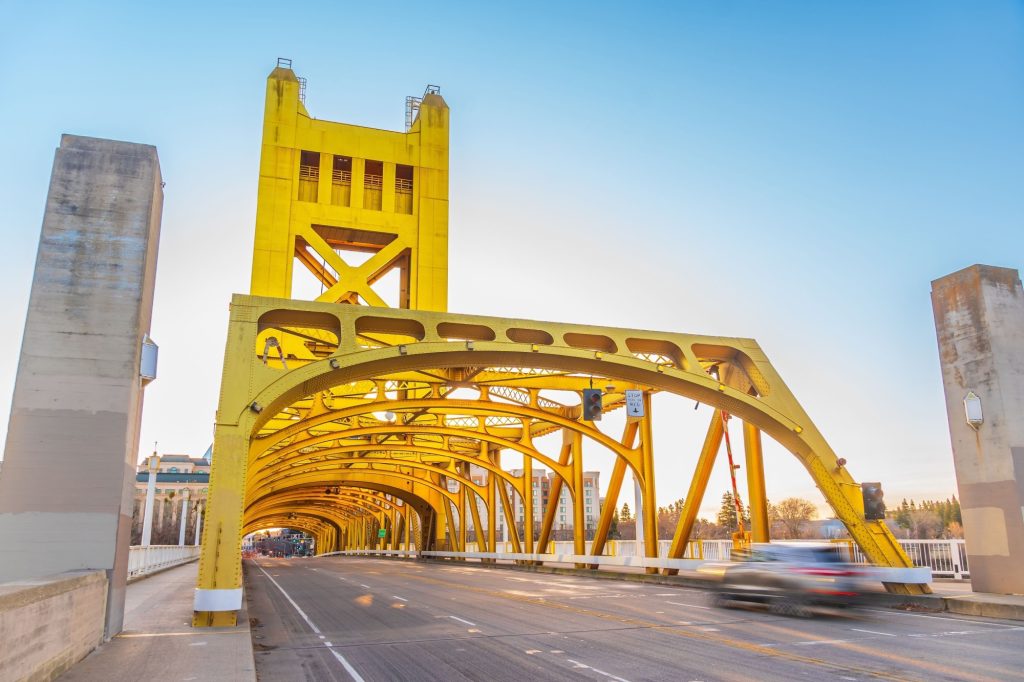
You probably don’t think twice about the color of a bridge when you drive over it. But those paint choices aren’t random. Sometimes, designers pick these colors specifically to make you react a certain way as you pass over. What colors do they choose & why? Let’s find out what’s going on behind those color choices.
Featured Image Credit: Shutterstock.
Cool hues make big steel feel lighter
Some steel bridges are painted pale blue or soft green, although not simply for looks. Those shades make massive structures seem a little less intimidating. In states like Minnesota & Maryland, they use cooler tones when they don’t want the bridge to dominate views of the local area, and doing so keeps things calm.
Blue-green palettes for lower arousal
Bridges near parks or rivers often have blue & green tones because those colors are linked to lower physiological arousal. Essentially, they help people stay steady and focused. You’ll usually see this color near quieter parkways, where the goal is to blend with the surroundings & make driving less stressful. Isn’t that nice?
Palettes account for color-vision deficiencies
A portion of the population sees colors differently, especially reds & greens. This means bridge colors can’t use those contrasts alone. As such, designers often pick orange or other high-visibility hues that are still clear for color-deficient drivers, so that the structure is easy to identify for everyone, no matter the lighting or distance.
Low-sheen finishes cut glare and workload
Unfortunately, glossy paint on bridges will cause glare straight into your eyes, which is especially common when the sun’s low. That’s why many agencies use matte or low-sheen finishes. It’s easier on drivers’ eyes & helps prevent you from squinting when you’re driving toward a brighter area.
Corridor palettes support quick recognition
Some stretches of highway feel cohesive, even when the bridges change. Usually, that’s on purpose. A lot of state agencies pick one color family and stick with it along the same route so that your brain recognizes it automatically after a few trips. You don’t spend extra energy figuring out where you are, making driving far easier.
Yellow–green accents boost peripheral detection
Whenever designers want something to stand out in your side vision, they’ll use yellow–green tones. This specific shade is a sweet spot for how our eyes pick up color during the day, so details pop faster, especially at the edges of your view. You’ll sometimes see it on rails or secondary bits of a bridge.
Specific hues can guide emotional framing during approaches
Also, the colors leading up to a bridge can set the mood before you hit the span. Agencies choose natural tones on the approach, then cooler shades on the main structure itself. Such a switch helps keep the experience familiar instead of jarring. Essentially, they’re trying to keep you focused and comfortable as you roll through.
The following sources were consulted in the preparation of this article:
- Traffic signal color recognition is a problem for both protan and deutan color-vision deficients
- Effects on Heart Rate Variability of Stress Level Responses to the Properties of Indoor Environmental Colors: A Preliminary Study
- Aesthetic Guidelines for Bridge Design
- Aesthetic Bridges – Users Guide
- The Impact of the Spectral Radiation Environment on the Maximum Absorption Wavelengths of Human Vision and Other Species
- Evaluating the impacts of color, graphics, and architectural features on wayfinding in healthcare settings using EEG data and virtual response testing
- Visual Detection and Recognition of Fluorescent Color Targets Versus Nonfluorescent Color Targets as a Function of Peripheral Viewing Angle and Target Size
- How the characteristics of street color affect visitor emotional experience