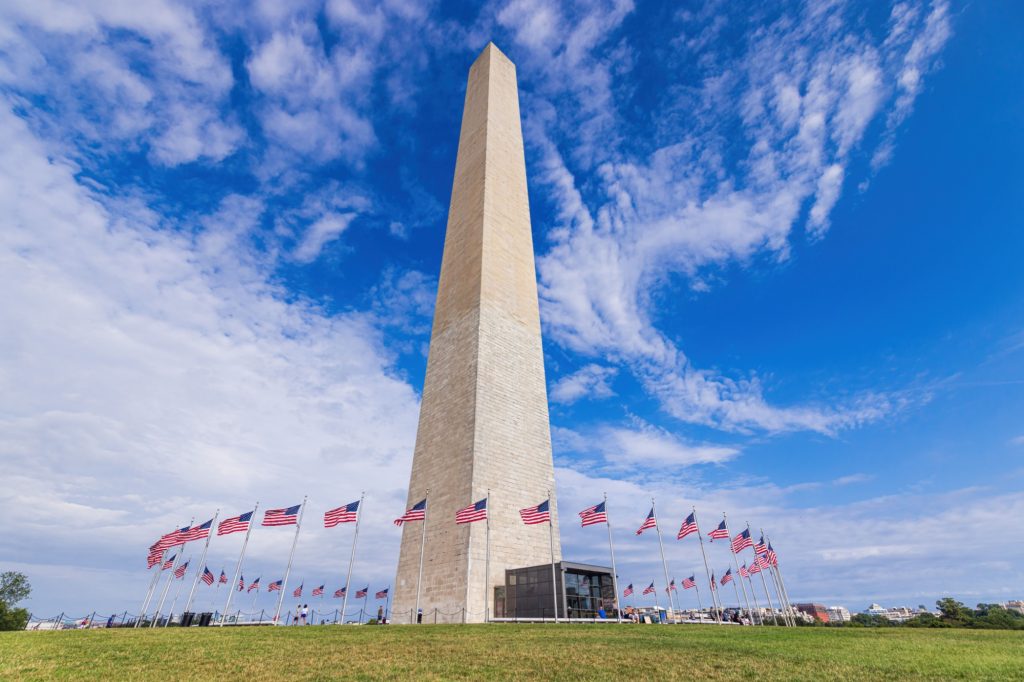
There’s a color split on the Washington Monument. But it isn’t a trick or some weird aging thing, as it’s actually from the stop-and-start building method over the decades. In fact, the different shades go all the way around the tower. How and why did this happen? That’s what we’re going to find out.
Featured Image Credit: Shutterstock.
The construction pause
Work on the monument hit a wall in the 1850s after money ran out & politics got messy, so construction simply stopped. The crews walked away and left the walls standing at around 150 feet tall. Eventually, the workers came back, but that was more than 20 years later. They now had to use new stone.
Texas, Maryland marble
The first batch of blocks came from Texas, Maryland, which is just north of Baltimore. All those chunks were cut & set before the project ran out of steam between 1848 & 1854. This marble has a slightly different grain and tone. As such, the bottom part of the monument looks warmer and a bit creamier. But that’s not the end of the story.
Early builders used different shims & mortar mixes
Near the base, the first crews set stones with lead shims & a lime mortar blend that included river sand and gravel. The shim thickness wasn’t consistent early on. As a result, they switched to heavier lead when the edges started chipping at the joints, and those early layers are still underneath everything that came later.
A four-course band
A few courses near the middle came from Sheffield, Massachusetts. These were just four layers that were added when work finally started up again, but the supplier had issues, so the deal didn’t last long. Yet those four courses are still there. They form a thin belt around the monument that’s quite difficult to see, but it’s there.
Cockeysville marble
Once that Sheffield marble didn’t work out, they switched to stone from Cockeysville, which is also in Maryland and is from the Beaver Dam quarry. This is a few miles from the earlier Texas source. After 1880, this was the only material they used all the way to the top, and that upper stone came in lighter. It gave the shaft that clear two-tone look.
Different mineral makeup
Yes, the two Maryland quarries were close, yet the rock wasn’t exactly the same. The early stone was mostly calcium carbonate, which is rather chunky & pure white, while the later stuff had more magnesium in it. It was also finer-grained. Over time, they’ve both weathered differently, and that’s another reason you can spot that seam so easily now.
Other details
The color break is at about 150 feet up. When they resumed in the 1870s, the workers actually chipped away some older blocks to stabilize them before building upward again. The U.S. Army Corps of Engineers took control of the monument & Thomas Lincoln Casey oversaw the second round.
The following sources were consulted in the preparation of this article: